
How much is the battery rebate?
Type your battery size and when it will be installed. You'll see your federal discount, what it drops to if you wait, and an estimate of payback. Free, no sign-up, and nothing you type leaves your device.
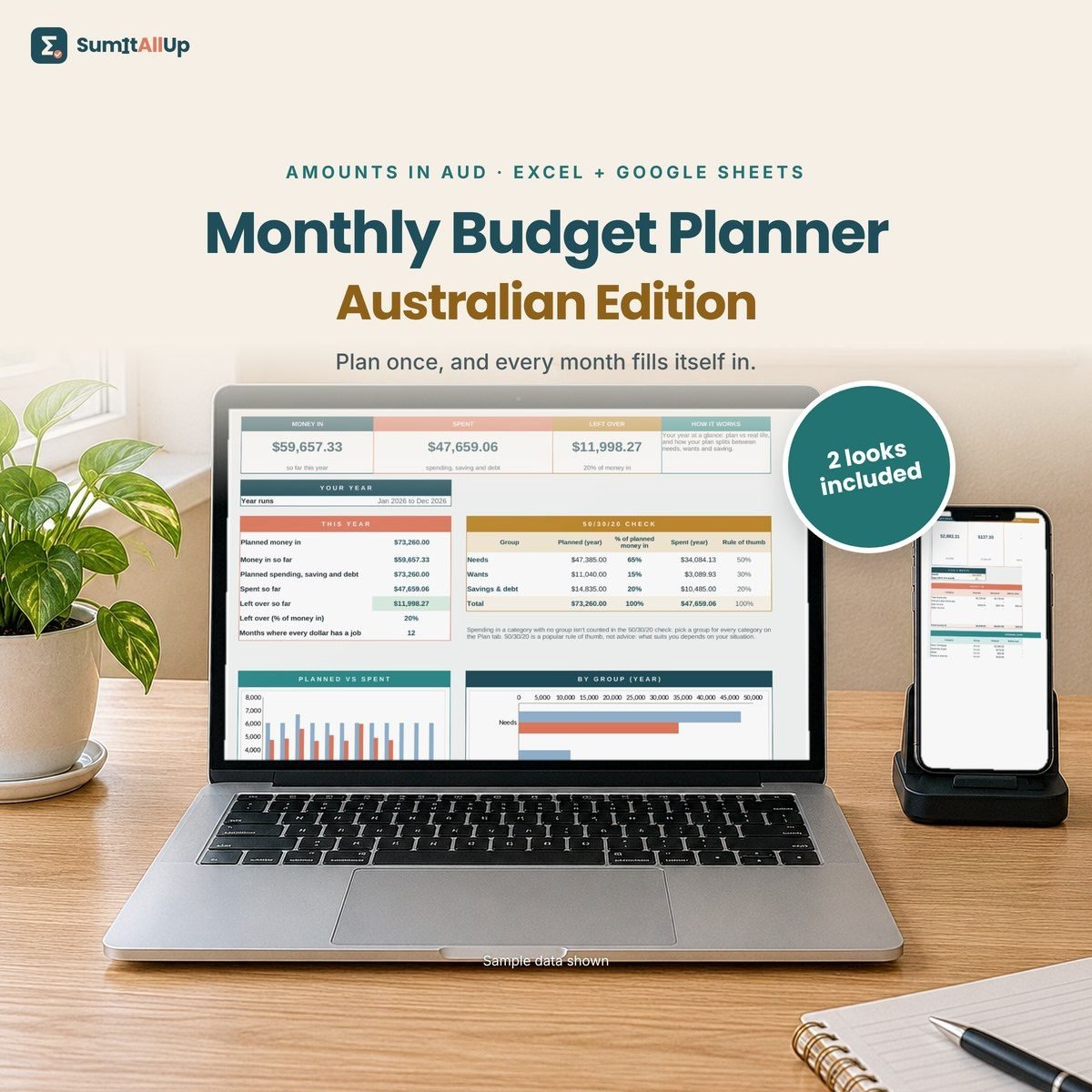
Want to see every bill in one place?
The Monthly Budget Planner spreadsheet tracks every bill and expense each month, shows where your money goes and what's left. Excel and Google Sheets. No app, no sign-up, no subscription.
How it works
The sum
The Cheaper Home Batteries Program gives you small-scale technology certificates (STCs) for each kWh of usable battery capacity. The number per kWh (the STC factor) is set by when the battery is installed. Since 1 May 2026 it tapers with size:
| Usable capacity | Share of the factor |
|---|---|
| First 14 kWh | 100% |
| Over 14 up to 28 kWh | 60% |
| Over 28 up to 50 kWh | 15% |
| Over 50 kWh | Nothing |
The result is rounded down to whole certificates, then multiplied by the certificate price.
The rate drops every six months
| Installed | STC factor |
|---|---|
| May to Dec 2026 | 6.8 |
| Jan to Jun 2027 | 5.7 |
| Jul to Dec 2027 | 5.2 |
| Jan to Jun 2028 | 4.6 |
| Jul to Dec 2028 | 4.1 |
| Jan to Jun 2029 | 3.6 |
| Jul to Dec 2029 | 3.1 |
| Jan to Jun 2030 | 2.6 |
| Jul to Dec 2030 | 2.1 |
The install date is the date the electrical safety certificate is signed.
Example
A 13.5 kWh battery installed in December 2026: 13.5 x 6.8 = 91.8, rounded down to 91 certificates. At $38 each, that's $3,458. Installed in January 2027: 13.5 x 5.7 = 76.95, so 76 certificates, or $2,888.
Who can get it
The battery must be installed with new or existing solar, have a label capacity of 5 to 100 kWh, be on the approved (CEC) product list, be able to join a virtual power plant if it's connected to the grid, and be installed by an accredited installer. Some states and territories also offer their own battery programs.
Payback
Each kWh you use from the battery is one you don't buy at your usage rate, but it's solar you no longer export for the feed-in tariff. So the saving is kWh per day x (usage rate minus feed-in tariff) x 365 days. Payback is the price after the discount divided by the yearly saving. It's a simple estimate: it leaves out time-of-use rates, virtual power plant payments, supply charges and battery wear, so your real result may differ.
Rules as at October 2026, from the Clean Energy Regulator and the Renewable Energy (Electricity) Regulations. Check the Clean Energy Regulator for the latest. This is a planning tool, not financial advice.